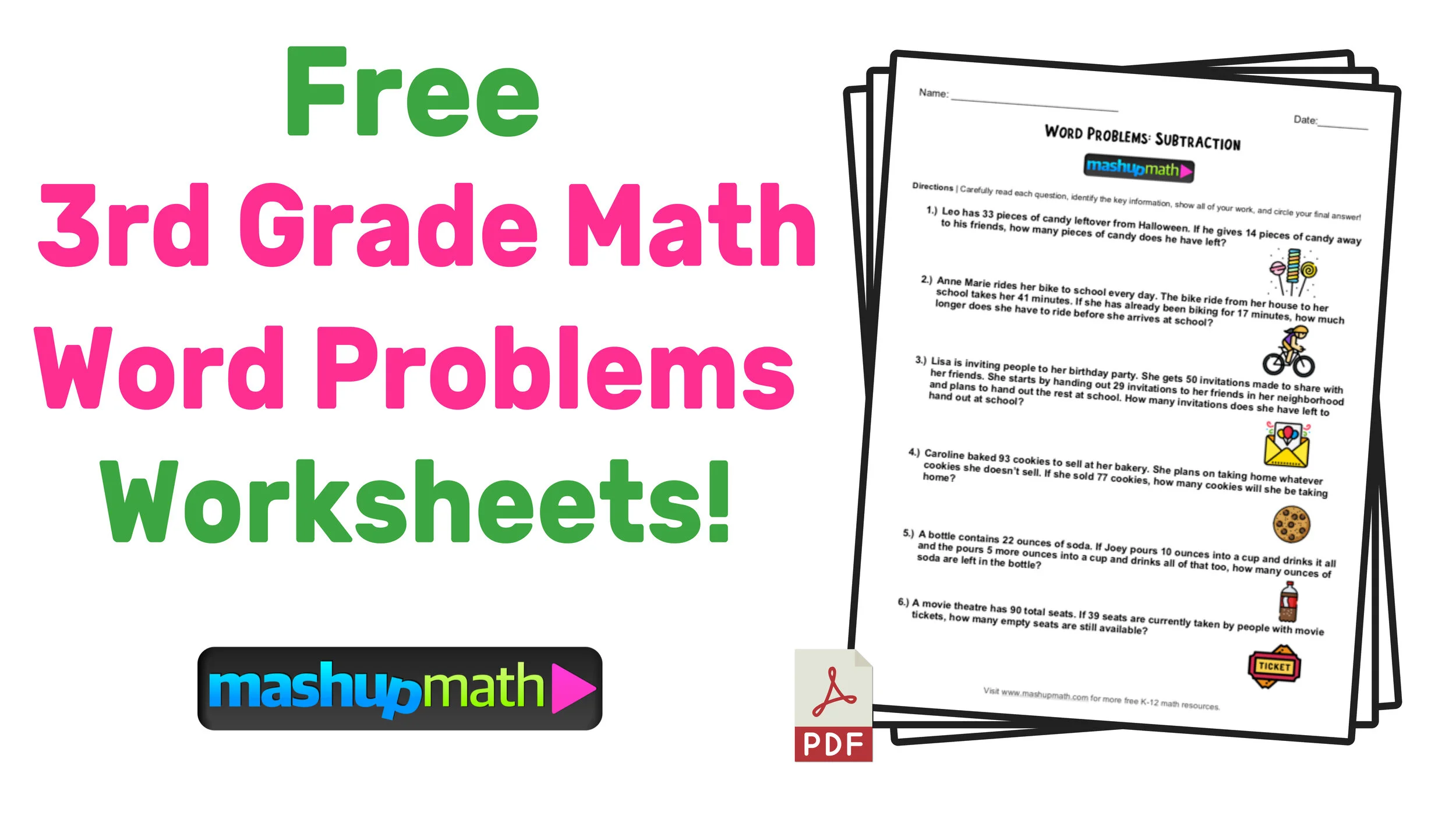
Fun and Challenging Math Word Problems for 3rd Grade

Why Word Problems are Important for 3rd Graders
As a parent or teacher, you want to help your 3rd-grade student develop a strong foundation in math. One effective way to do this is by using math word problems. These problems present real-life scenarios that require mathematical solutions, making them an excellent way to apply math concepts to everyday situations. By practicing word problems, your child will improve their critical thinking skills, learn to approach problems from different angles, and build confidence in their math abilities.
Word problems are an essential part of the 3rd-grade math curriculum. They help students transition from basic arithmetic operations to more complex, multi-step problems. By solving word problems, students learn to read carefully, identify the question being asked, and choose the correct mathematical operation to solve the problem. This skill is crucial in real-life situations, where math is often presented in a word problem format.
Examples of Math Word Problems for 3rd Grade
Word problems are important for 3rd graders because they help students develop a deeper understanding of math concepts. By applying math to real-life scenarios, students see the relevance and importance of math in their everyday lives. This motivation can spark a love for math and learning, leading to greater academic success. Additionally, word problems help students develop problem-solving skills, such as analyzing information, identifying patterns, and making logical conclusions.
Here are some examples of math word problems suitable for 3rd grade: 'Tom has 12 pencils in his pencil case. He gives 2 to his friend. How many pencils does Tom have left?' or 'A bookshelf has 5 shelves, and each shelf can hold 8 books. If the bookshelf is currently empty, how many books can be placed on it in total?' These types of problems can be found in many math workbooks or online resources, and can be adapted to fit your child's interests and learning style. By practicing these problems, your child will become more confident and proficient in math, setting them up for success in future math classes.